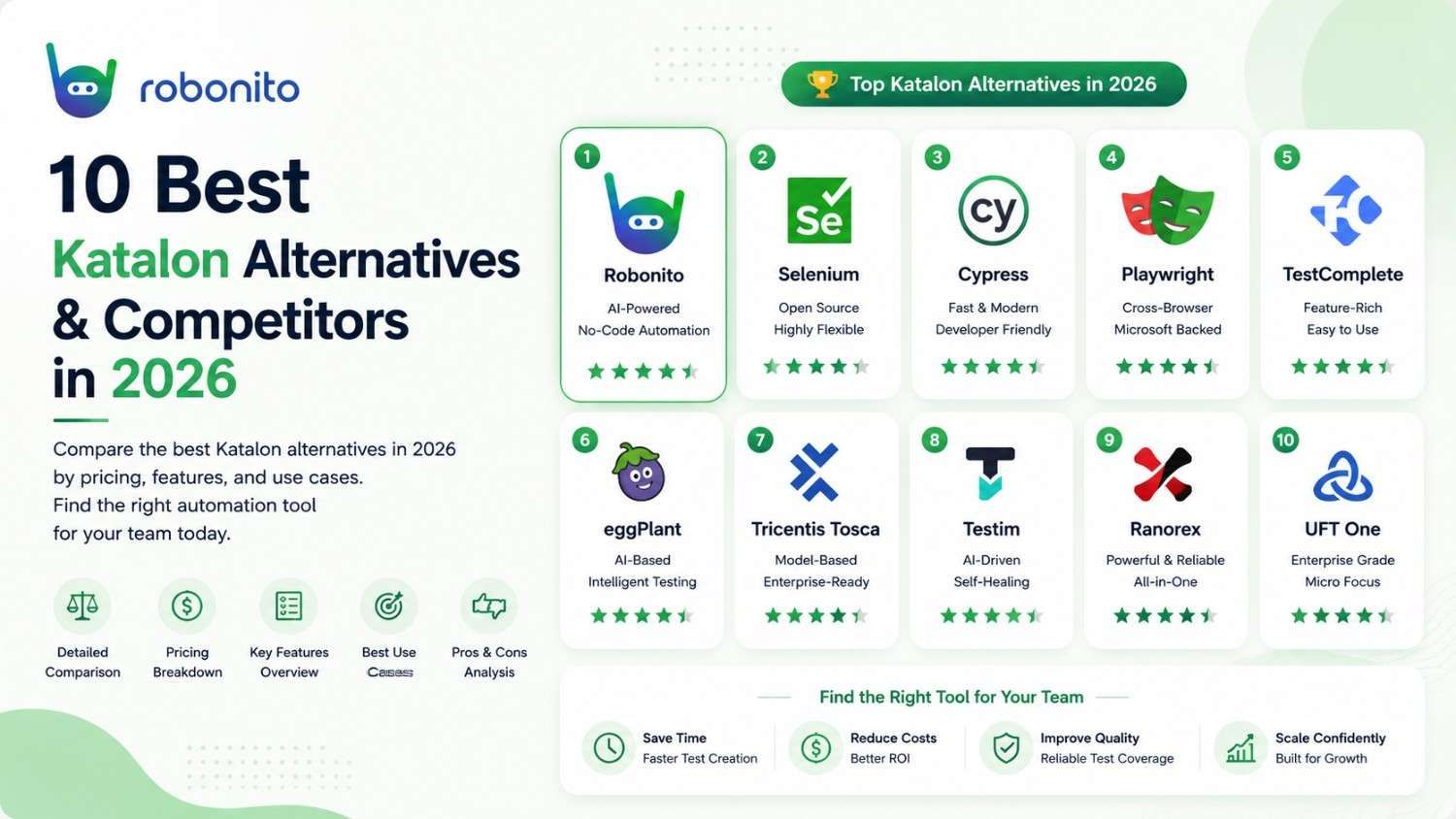
Katalon was a great tool in 2020. In 2026, teams are leaving for three reasons: pricing after the Perforce acquisition, heavy resource consumption, and AI-powered competitors that self-heal broken tests automatically. This guide compares the 10 best alternatives honestly — with pricing, real limitations, and a clear recommendation for each team type.
By Robonito Engineering Team · Updated May 2026 · 16 min read
Why teams are switching from Katalon in 2026
Katalon Studio built its reputation as a comprehensive, beginner-friendly automation platform that worked out of the box. For many teams in the 2018–2022 era, it was the easiest path from manual testing to automation.
The landscape has shifted. Since the Perforce acquisition, Katalon's pricing has increased significantly, particularly for teams that need enterprise features like unlimited parallel execution and advanced integrations. Meanwhile, the broader testing ecosystem has matured dramatically — Playwright has largely replaced Selenium as the standard for web UI testing, AI-powered self-healing is now table stakes in modern platforms, and no-code tools have become genuinely capable rather than just marketing positioning.
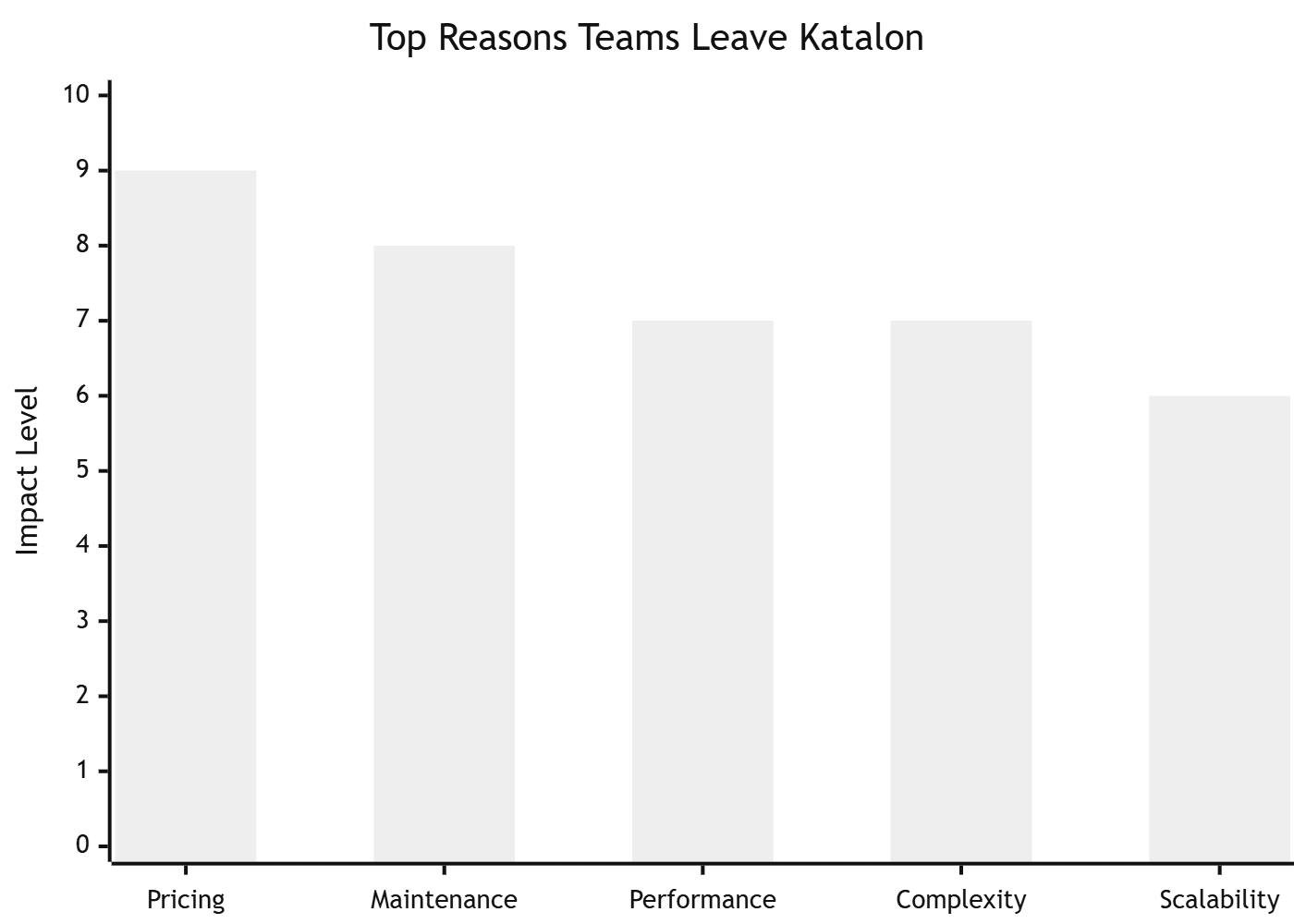
The most common reasons teams cite for switching:
- Pricing — Katalon's per-user licensing model becomes expensive at scale compared to usage-based alternatives
- Performance — Katalon is resource-heavy on local machines compared to Playwright or Cypress
- Self-healing — Limited automatic test recovery when UI changes, compared to AI-native platforms
- Non-technical access — Non-coding team members still struggle with Katalon's complexity despite its "low-code" positioning
- Maintenance overhead — Test suites built on Katalon's Groovy-based scripting still require significant upkeep
This guide covers the 10 strongest alternatives, what each one genuinely does well, where each one falls short, and which team type each suits best.
Quick comparison matrix
| Tool | Coding required | Best for | Free tier | Pricing from |
|---|---|---|---|---|
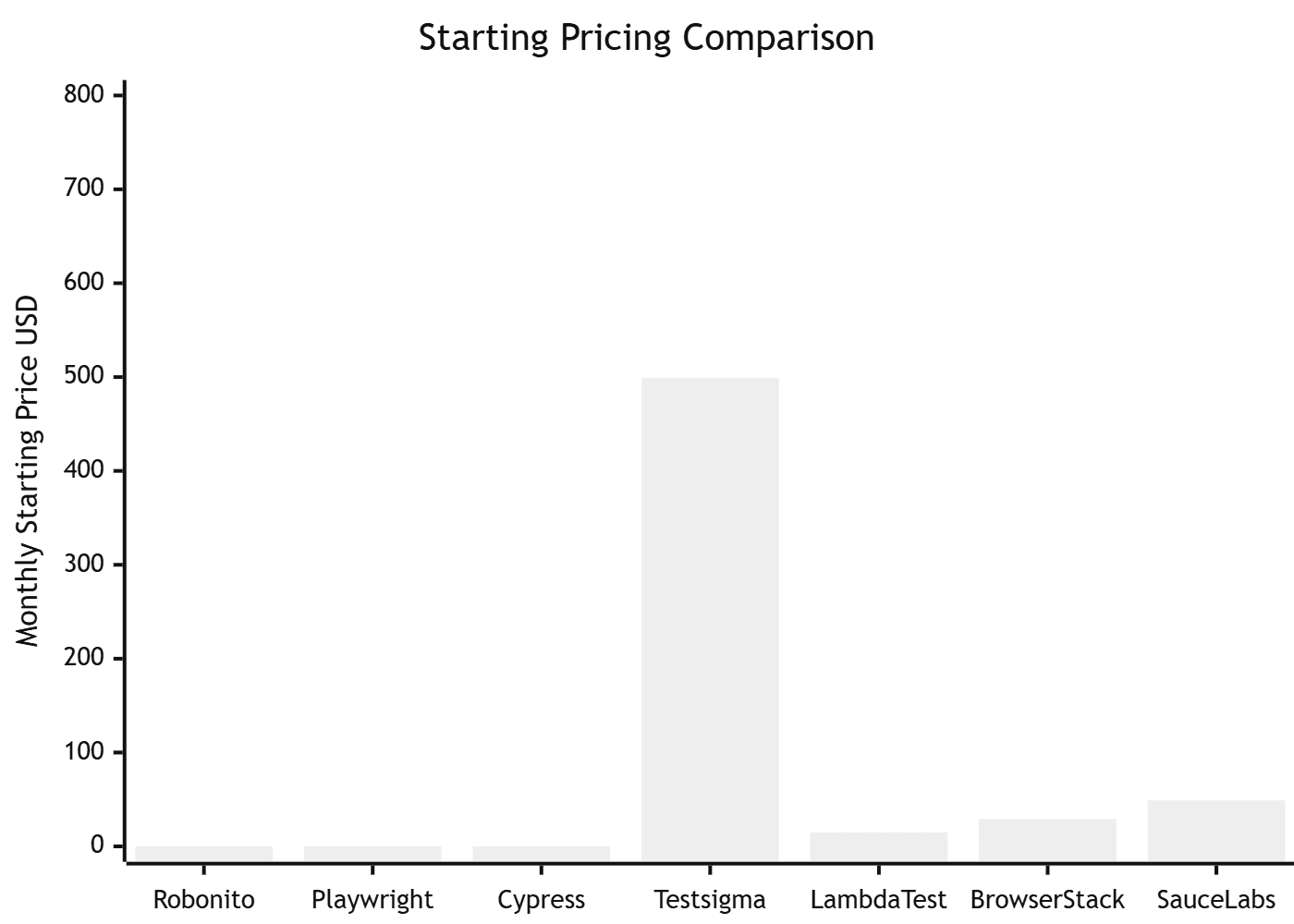
| Robonito | None | No-code, AI self-healing, fast setup | ✅ | Free |
| Playwright | Yes (JS/TS/Python/Java) | Engineering-led web UI + API | ✅ OSS | Free |
| Cypress | Yes (JavaScript only) | Frontend JS teams, component testing | ✅ OSS | Free |
| Testsigma | None (NL authoring) | Non-technical teams, cloud-first | ❌ | ~$499/mo |
| LambdaTest | Yes | Cross-browser cloud testing | ✅ | $15/mo |
| BrowserStack | Yes | Real device cloud, cross-browser | ✅ (limited) | $29/mo |
| Selenium | Yes (all major languages) | Complex, custom, open-source | ✅ OSS | Free |
| Appium | Yes | Mobile (iOS + Android) | ✅ OSS | Free |
| Sauce Labs | Yes | Enterprise cross-browser + mobile | ❌ | ~$49/mo |
| ReadyAPI (SmartBear) | Low | API testing, SOAP + REST | ❌ | ~$749/mo |
The Katalon alternative that requires zero code
Robonito auto-generates tests, self-heals when your UI changes, and runs in CI — no Groovy scripts, no maintenance sprints, no per-user licensing traps. Try Robonito free →
The 10 best Katalon alternatives in 2026
1. Robonito — Best for no-code AI automation
robonito.com · Free tier available · No coding required
Robonito is the strongest Katalon alternative for teams that want the power of automation without the scripting overhead. Where Katalon still requires Groovy scripting for anything beyond basic record-and-playback, Robonito uses AI to generate, execute, and maintain tests entirely without code.
The core differentiator is self-healing. When your UI changes — a button moves, a class name updates, a form gets restructured — Robonito detects the change and updates the test automatically. Teams that previously spent 2–4 days per Katalon maintenance cycle after every significant UI update report reducing that to under 30 minutes with Robonito.
What Robonito does well:
- Auto-generates tests from recorded user flows or natural language descriptions
- Self-heals broken tests when UI changes — no manual selector updates
- Tests both web UI and APIs in the same platform
- Full CI/CD integration (GitHub Actions, GitLab, Jenkins) from day one
- Non-technical team members — QA analysts, product managers — can create and maintain tests independently
- 98% reduction in testing time reported by teams including Club Car (500 hours → 2 hours)
Honest limitations:
- Less suited for deeply custom business logic validation requiring precise mathematical assertions
- Not a performance load testing tool — use k6 or JMeter for that
- Younger ecosystem than Selenium or Cypress — fewer community tutorials
Best for: Agile teams with mixed technical/non-technical QA, companies wanting to eliminate test maintenance overhead, teams running frequent releases where UI stability is a constant challenge.
Pricing: Free tier with generous limits. Paid plans competitive — see current pricing at robonito.com/pricing.
2. Playwright — Best for engineering-led teams
playwright.dev · Open source · Free
Playwright is Microsoft's modern web testing framework and has become the de facto standard for engineering teams replacing both Katalon and Selenium. Released in 2020 and now mature, it addresses almost every limitation that made Selenium frustrating for Salesforce and modern web app testing.
Unlike Katalon, Playwright does not try to abstract testing behind a GUI — it is a code-first framework built for engineers. What it offers in return is speed (parallel execution by default), reliability (auto-waiting eliminates most flakiness), and genuine cross-browser support including Safari via WebKit.
What Playwright does well:
- Runs tests on Chromium, Firefox, and WebKit (Safari) natively
- Auto-waits for elements — eliminates most
sleep()related flakiness - ARIA-first selector strategy makes tests more stable than CSS/XPath
- Built-in visual regression with
toHaveScreenshot() - Supports TypeScript, JavaScript, Python, Java, and C# out of the box
- Free, open source, actively maintained by Microsoft
Honest limitations:
- Requires coding — not usable by non-technical team members
- No built-in test management UI (Katalon has one)
- Self-healing must be implemented manually or via third-party tools
Best for: Engineering teams, companies replacing Selenium or Katalon who have developers owning test automation, TypeScript/JavaScript shops.
Pricing: Free and open source.
3. Cypress — Best for JavaScript frontend teams
cypress.io · Open source core · Free
Cypress built its reputation on developer experience. Its test runner runs directly inside the browser, giving you real-time test execution visibility, time-travel debugging (step back through any test action with screenshots), and an interactive element inspector. For teams building React, Vue, or Angular applications, Cypress's component testing mode is particularly powerful — testing individual components in isolation without spinning up the full application.
What Cypress does well:
- Exceptional developer experience — best-in-class debugging
- Component testing for React/Vue/Angular without a browser
- Network request interception and mocking built in
- Real browser execution (not WebDriver-based)
- Active community, extensive plugin ecosystem
Honest limitations:
- JavaScript/TypeScript only — no Python, Java, or C# support
- No native Safari support (WebKit support is in beta as of 2026)
- Cannot test multiple browser tabs simultaneously
- Slower for large parallel test suites compared to Playwright
- Cypress Cloud (for parallelisation and test analytics) adds cost
Best for: JavaScript frontend teams, React/Vue/Angular component testing, teams that prioritise developer experience and interactive debugging over multi-language support.
Pricing: OSS core is free. Cypress Cloud starts at ~$75/month for parallelisation and analytics.
4. Testsigma — Best for natural language test authoring
testsigma.com · No free tier · No coding required
Testsigma occupies a similar space to Robonito — no-code, cloud-native, accessible to non-technical testers — but with a different approach. Its primary differentiator is natural language test authoring: testers write test steps in plain English ("Click on the Login button", "Verify that the page title is Dashboard") and Testsigma executes them. This makes it particularly well-suited for business analysts who want to author tests in the language of requirements rather than the language of code.
What Testsigma does well:
- Natural language test steps — genuinely accessible to non-technical authors
- Cloud-based — no local installation, accessible from anywhere
- Supports web, mobile (iOS/Android), and API testing
- Test reports with graphical representations including screenshots
- Integrates with Jenkins, JIRA, and Slack
Honest limitations:
- No meaningful free tier — pricing starts around $499/month
- Natural language authoring works well for simple flows but requires workarounds for complex conditional logic
- Less mature self-healing than AI-native platforms
- Smaller community than Selenium or Cypress
Best for: Enterprise teams with non-technical business analysts who author test cases, organisations where test readability for non-engineers is the primary requirement.
Pricing: Starts at approximately $499/month. No free tier.
5. LambdaTest — Best for cross-browser cloud testing on a budget
lambdatest.com · Free tier available · Coding required
LambdaTest is a cloud-based testing platform that gives you access to 3,000+ real browser and device combinations without managing any local infrastructure. You write your Selenium, Playwright, or Cypress tests as normal, then point them at LambdaTest's cloud grid instead of a local browser. Tests run in parallel across your target environments and results come back with screenshots, video recordings, and logs.
What LambdaTest does well:
- 3,000+ browser/OS/device combinations in the cloud
- Runs existing Selenium, Playwright, Cypress, and Appium tests without modification
- Live interactive testing for manual cross-browser verification
- Competitive pricing — significantly cheaper than Sauce Labs and BrowserStack for most use cases
- Smart UI visual regression testing included
Honest limitations:
- Not a test creation tool — you still need Selenium or Playwright to write the tests
- Cloud execution adds latency compared to running locally
- Some enterprise features (dedicated VMs, IP whitelisting) only on higher-tier plans
Best for: Teams with existing Selenium or Playwright suites that need affordable cross-browser cloud execution, teams doing manual cross-browser spot-checking alongside automation.
Pricing: Free tier (limited concurrent tests). Paid from ~$15/month.
6. BrowserStack — Best for real-device mobile testing
browserstack.com · Limited free tier · Coding required
BrowserStack is the market leader in real-device cloud testing. Unlike emulator-based testing, BrowserStack runs your tests on actual physical devices — real iPhones, real Android phones, real tablets — housed in their data centres. This is critical for catching device-specific bugs that emulators miss: rendering differences, touch interaction issues, and OS-level behaviour variations.
What BrowserStack does well:
- Real physical devices — not emulators or simulators
- 3,500+ device/browser combinations
- Automate (Selenium/Appium/Playwright) and App Live (manual testing) in one platform
- Percy for visual regression testing
- Strong CI/CD integration
Honest limitations:
- More expensive than LambdaTest for equivalent device coverage
- No test creation tools — you bring your own automation framework
- Queuing delays on popular device configurations during peak hours
Best for: Mobile-first teams that need real-device testing, companies where iOS/Android visual fidelity is critical, teams that have already written Appium tests and need a device farm.
Pricing: Limited free trial. Automate from ~$29/month. App Automate (mobile) from ~$29/month separately.
7. Selenium — Best for maximum flexibility and open-source control
selenium.dev · Open source · Free · Coding required
Selenium is the foundation on which half the world's test automation was built. It is not the most exciting choice in 2026 — Playwright has largely superseded it for new projects — but it remains the right choice in specific contexts: legacy Java or .NET codebases where rewriting the test suite is not viable, large enterprise environments with extensive Selenium infrastructure already in place, and situations where maximum language and framework flexibility matters.
What Selenium does well:
- Supports Java, Python, C#, Ruby, JavaScript, Kotlin — more language options than any competitor
- Massive community — more tutorials, Stack Overflow answers, and integrations than any other tool
- WebDriver standard ensures broad browser compatibility
- Free and open source with no licensing risk
- Works with every major CI/CD platform
Honest limitations:
- No auto-waiting — requires explicit waits or suffers from flakiness
- Significantly slower than Playwright for the same test suite
- No built-in visual regression, no component testing
- High maintenance overhead for dynamic modern web apps
- Requires Selenium Grid for parallel execution — infrastructure overhead
Best for: Legacy codebases already on Selenium, Java/.NET enterprise teams, situations where the existing investment in Selenium infrastructure makes migration cost-prohibitive.
Pricing: Free and open source.
8. Appium — Best for mobile automation
appium.io · Open source · Free · Coding required
Appium is the open-source standard for mobile test automation. It uses the WebDriver protocol to automate iOS and Android applications — native apps, hybrid apps, and mobile web — using the same API. The key advantage over mobile-specific tools is code reuse: a test flow written once can run on both iOS and Android with minimal modification.
What Appium does well:
- iOS and Android automation from a single codebase
- Tests native apps, hybrid apps, and mobile browsers
- Supports all major programming languages (Java, Python, JavaScript, Ruby, C#)
- No app modification required — tests against production builds
- Works with BrowserStack and LambdaTest device farms
Honest limitations:
- Significantly more complex to set up than web testing tools
- Slower test execution than native iOS (XCUITest) or Android (Espresso) frameworks
- Mobile element identification is harder and more fragile than web
- Requires deep mobile platform knowledge to use effectively
Best for: Teams needing cross-platform mobile automation from a single framework, organisations that want to avoid vendor lock-in for mobile testing.
Pricing: Free and open source. Pair with BrowserStack or LambdaTest for cloud device execution.
9. Sauce Labs — Best for enterprise cross-browser and compliance
saucelabs.com · No free tier · Coding required
Sauce Labs is the enterprise-grade cloud testing platform. It covers web, mobile, API, and visual testing across thousands of browser and device combinations — similar to BrowserStack and LambdaTest but with a stronger enterprise focus: dedicated virtual machines, IP whitelisting, SOC 2 Type II compliance, and enterprise SLAs that smaller platforms do not offer.
What Sauce Labs does well:
- Enterprise security and compliance (SOC 2, HIPAA-ready)
- Dedicated VMs for consistent, unshared test environments
- Broad framework support (Selenium, Playwright, Cypress, Appium, Espresso, XCUITest)
- Sauce Visual for AI-powered visual regression
- Extensive CI/CD integrations
Honest limitations:
- No free tier — pricing starts around $49/month and rises quickly
- Overkill for small to mid-size teams who do not need enterprise compliance
- More expensive than LambdaTest for equivalent basic functionality
- Does not include test creation — you still write your own automation
Best for: Enterprise teams with compliance requirements (healthcare, finance, government), organisations where dedicated test environments are a security requirement.
Pricing: No free tier. From ~$49/month. Enterprise plans require custom quotes.
10. ReadyAPI by SmartBear — Best for API and SOAP/REST testing
smartbear.com/readyapi · No free tier · Low-code
A note on SmartBear: they are a software company that owns multiple products, not a single tool. Their most relevant Katalon alternative is ReadyAPI — a comprehensive API testing platform that covers REST, SOAP, GraphQL, and microservices testing with both functional and load testing capabilities. For teams whose primary testing need is API coverage rather than UI automation, ReadyAPI is one of the most feature-complete options available.
What ReadyAPI does well:
- REST, SOAP, GraphQL, and microservices API testing in one platform
- Both functional and load/performance testing without switching tools
- Contract testing and API mocking built in
- Test generation from OpenAPI/Swagger specs
- Strong enterprise support and documentation
Honest limitations:
- Expensive — starts around $749/month for teams
- Heavy, desktop-based interface that feels dated compared to modern tools
- Significant learning curve
- UI testing requires a separate SmartBear product (TestComplete, additional cost)
Best for: Enterprise teams with complex SOAP and legacy API testing requirements, organisations already in the SmartBear ecosystem (Zephyr, TestComplete).
Pricing: No free tier. ReadyAPI from ~$749/month.
Which Katalon alternative is right for your team?
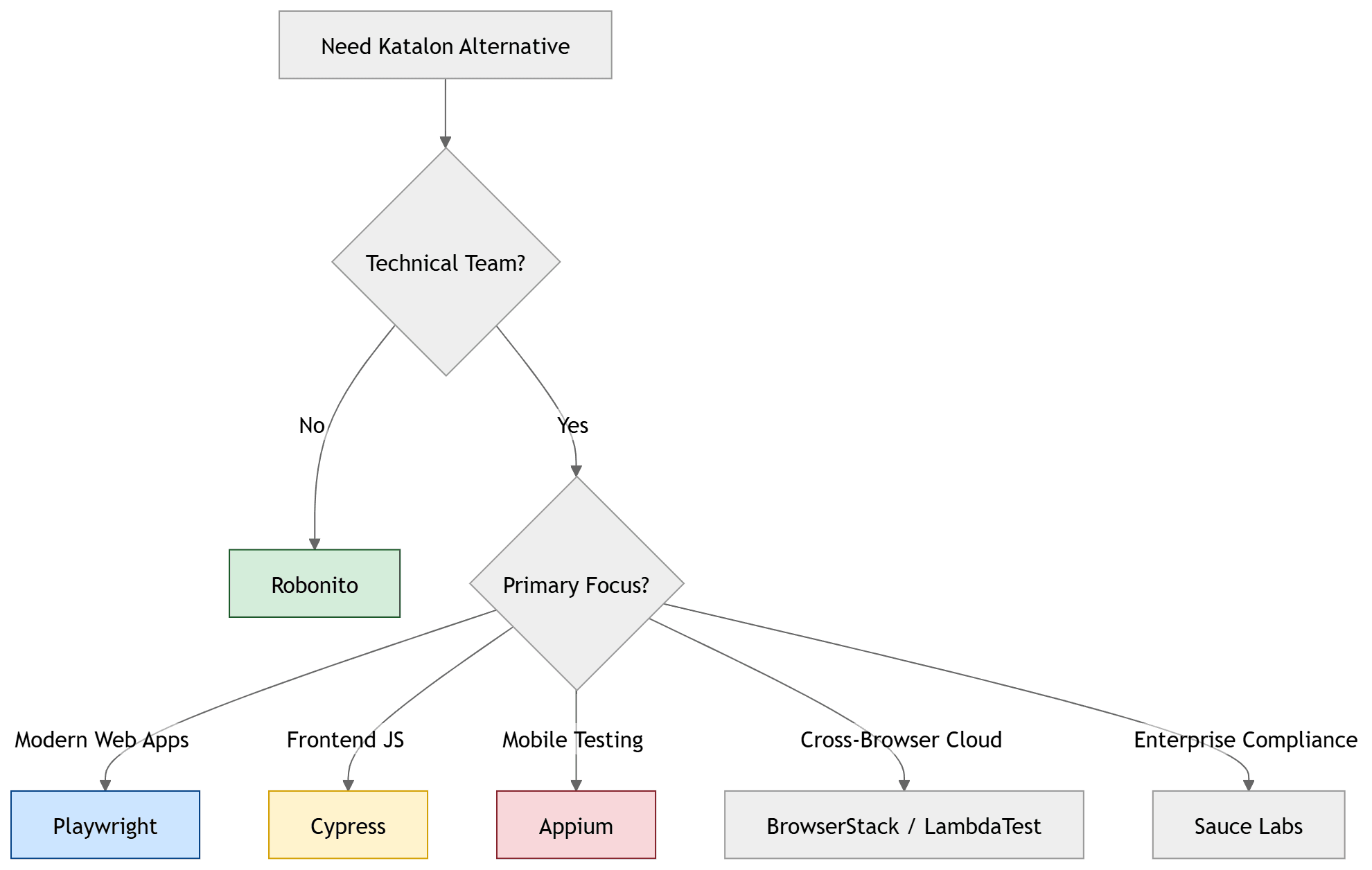
Use this decision guide to short-list your options based on your primary constraints:
| Your situation | Best choice | Why |
|---|---|---|
| Non-technical QA team, no coding | Robonito | Zero code, self-healing, fastest setup |
| Engineering team, modern web app | Playwright | Fastest, most stable, free |
| JavaScript frontend, React/Vue/Angular | Cypress | Best dev experience, component testing |
| Natural language test authoring | Testsigma | Plain English steps, cloud-native |
| Cross-browser on a budget | LambdaTest | 3,000+ combinations, cheapest cloud |
| Real device mobile testing | BrowserStack | Physical devices, not emulators |
| Legacy Java/.NET codebase | Selenium | Maximum language support, existing investment |
| Cross-platform mobile automation | Appium | iOS + Android from one codebase |
| Enterprise compliance (SOC 2/HIPAA) | Sauce Labs | Dedicated VMs, compliance certifications |
| Complex API + SOAP testing | ReadyAPI | REST, SOAP, GraphQL in one platform |
The honest recommendation for most teams in 2026:
If you are leaving Katalon because of maintenance overhead and non-technical team access, Robonito solves both problems directly — no code, self-healing, and a free tier to evaluate before committing.
If you are leaving Katalon because of performance and you have an engineering team comfortable with code, Playwright is the cleaner, faster, free replacement.
If your primary reason for leaving is cost, both Playwright and Selenium eliminate licensing entirely.
Frequently Asked Questions
Why are teams looking for Katalon alternatives in 2026?
The main reasons are pricing increases following the Perforce acquisition, heavy resource consumption compared to modern tools like Playwright, limited self-healing capabilities versus AI-native platforms, and non-technical testers still finding Katalon's interface complex despite its low-code positioning.
What is the best free alternative to Katalon Studio?
Playwright is the best free alternative for engineering teams — faster, more stable, and better maintained than Selenium, with support for TypeScript, Python, Java, and C#. Robonito offers a generous free tier for teams wanting no-code automation without any upfront cost.
What is the best Katalon alternative for non-technical testers?
Robonito is the strongest choice — it requires no coding, auto-generates tests from user flows, and self-heals when the UI changes. Testsigma is a strong second with natural language test authoring, though it has no free tier.
What is the best Katalon alternative for mobile testing?
Appium is the open-source standard for cross-platform mobile automation across iOS and Android. For real-device cloud execution without managing a device lab, pair Appium with BrowserStack or LambdaTest.
Is Katalon Studio still worth using in 2026?
Katalon remains reasonable for teams already invested in it who are not under pricing pressure and whose test suites are stable. For new projects, most teams find Playwright (engineering-led) or Robonito (mixed teams) to be faster, cheaper, and more maintainable starting points in 2026.
How long does it take to migrate from Katalon to a new tool?
Migration time depends heavily on your suite size and chosen replacement. Migrating a 100-test Katalon suite to Playwright typically takes 1–2 weeks. Migrating to a no-code platform like Robonito is faster because tests are re-recorded rather than re-coded — most teams complete critical-path coverage in 2–3 days.
The Katalon alternative your whole team can actually use
Robonito replaces Katalon's script-heavy approach with AI-powered no-code automation — self-healing tests, zero maintenance sprints, and a free tier to get started today. Teams switching from Katalon to Robonito are live with full regression coverage in under a week. Start free at Robonito.com →
Automate your QA — no code required
Stop writing test scripts.
Start shipping with confidence.
Join thousands of QA teams using Robonito to automate testing in minutes — not months.